Fascial Adhesions, undetected are a silent killer, literally. I’m really excited to share this information on fascial adhesions, because many people just don’t realize how common emotional issues and physical issues originate from the fascial system. Hopefully you’ve read my first blog post about what fascia is , if not, I suggest that you find your way over to that page. If so, i’m happy to bring the topic of fascia adhesions to your attention..
What are adhesions?
When soft tissue gets impacted after any kind of trauma, it becomes scar tissue – that’s what adhesions are. Adhesions untreated usually become worse after a while & this can eventually then result in hard, tender knots created in the muscles or in the fascial sheets, called trigger points. When this happens the fascia will begin to compress and contort the muscles or/ and organs it surrounds. Many people are suffering from conditions caused by fascial adhesions right now & are completely unaware. Fascia is our “secret organ” ,so many are oblivious of its exsistance or involvement.
These Fascial adhesions are silent killers , because they can damage nerves, block blood flow & restrict mobility, etc, leaving you with chronic pain and overall bodily dysfunction.
HOW & WHY MUSCLE ADHESIONS OCCUR
The reason our body creates adhesions is because its the body’s response to injury, trauma, and just overuse. It’s as if your body is literally building armour as a way to protect against said trauma.
Sometimes you can even see the knots’ form under the skin . They feel similar to that of lymph nodes.
I like the explantion an article gave explaining how they can occur, so i’m just going to share their prespective here:
When trauma infliction doesn’t heal completely or properly, the body creates collagen, to heal the damaged tissue. The collagen fibers will then clump together but without the alignment of the natural structure in the tissue, and unlike the smooth soft tissues in the muscle, the adhesion(fascia) is “sticky”. The fascia begins to “stick” to other tissues, which creates tension from those tissues pulling on each other. You can think of fascia like cling wrap — it clings to itself and other tissues until you can flatten it out.
Adhesions restrict movement and cause damage to the surrounding area, triggering more inflammation. The increase in inflammation tells the body to send in more collagen links, resulting in even more adhesion development. Over time as movement of the area becomes more restricted, the adhesions harden and solidify.
https://www.epicwellnessvt.com/how-muscle-adhesions-are-formed/
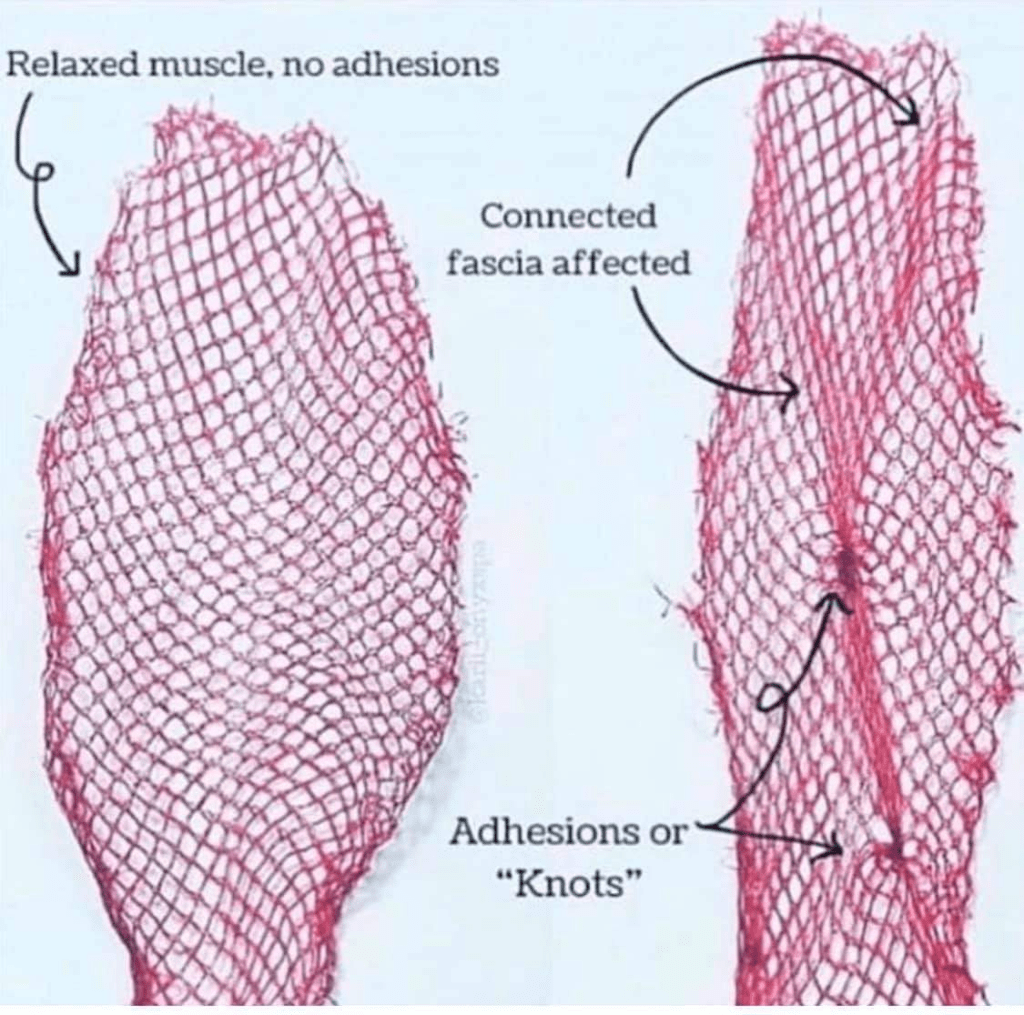
In this image above it shows you what a healthy fascial sheet looks like(left), and how a traumatized one will appear(right). This contortion of the fascial sheet on the right is what squeezes and restricts the local organs, muscles and blood flow.
The Emotional Impact
The way our bodies respond to our emotions is through our fascia. Our emotions (energy in motion) will carry through our entire fascia structure. When we refrain from allowing that said emotion to fully pass through our fascial system, it becomes trapped.
It’s really good to know that the position of the body will encourage certain emotions and when there is a myofascial shift, it will ultimately lead to postural unalignment .
A unified fascial system impacts movement but it also impacts your emotions. When there’s imbalances in the fascial network it can cause an emotional change in the person. This emotional shift can stem from consistant, myofascial, non-physiological, nerve signals .
How do you treat fascial adhesions?
Now we are getting to my favorite part , myofascial release. Now there are many ways in which you can straighten your fascial sheet. To name a couple: Massage therapy, foam rolling, surgery, Acupuncture, yoga, etc.
What happens in a myofascial release is that your tensed muscles and fascia will begin to relax & extend ,because of the increase of circulation and blood flow in that area. This will then help the fascia to become more malleable and it’ll eventually loosen up enough to restore mobility in the area. Relieving the pressure on any local organs or muscles and returning the structure to a more functional position. Releasing fascia can take time depending on the severity of the adhesions, because it only restores to delicate and steady handling.
The Effects after
One of the side effects i’ve noticed personally on my myofascial release journey, is that old memories began to come up. Good and Bad. More often though, i’d be confronted with the unpleasent, traumatic memories.
This is a good thing though. Why? well, because I never allowed the feelings I endured during the trauma to fully pass through or i’ve never even made sense of what happen to me , it was laying dormant in my body , THE ENTIRE TIME SINCE!
Breaking through these fascial adhesions are also like breaking through emotional blocks. once you start to work on an adhesion the emotions that get blocked or tangled in there will begin to release also. Sometimes while massaging , i’d cry randomly. Other times an event that happened to me would play over and over in my head for weeks until I made peace with it. Everyone is different and so are our experiences, so my side effects may be different than yours will be.
When you begin your myofascial release journey, be prepared to encounter many emotions & memories you’ve suppressed as a way to protect yourself. When you massage these adhesions it’s like sending a message to your body saying ” we’re safe now, you can relax “. This message will allow your body to release everything it was holding back: emotions, memories, physical tension and pain.
Sometimes when releasing these adhesions it can get painful , personally I love the pain and I continue through with the procedure anyway, but I don’t recommend injuring yourself. Just move at your own comfortability and pace when performing your own release sessions. (:
 FONTÈ FITNESS